Itasha: 5 Build Rules to Design an Anime Car Wrap
Updated October 2, 2026
Quick fit: An itasha is a motor vehicle decorated with fictional character artwork, originating from Japanese pop subculture. A successful build balances personal style with daily-driver practicality by selecting a clear three-tone color story, measuring every body panel before printing, using durable cast vinyl, and keeping vision glass fully compliant with local vehicle codes.
Personalizing a car always starts with an honest question: how much attention do you actually want on your daily commute? For decades, car culture separated itself into neat boxes of track builds, show cars, and audio projects. But across the parking lots of Tokyo, Akihabara, and increasingly North American cities, a completely different styling philosophy took over the streets. An itasha car turns sheet metal and clearcoat into a canvas for anime, manga, and video game illustration, transforming an ordinary commuter vehicle into an unmistakable rolling showcase.
When you decide to build your own itasha, excitement often leads to rushed decisions. Enthusiasts download low-resolution images off fan forums, buy cheap calendered sticker sheets, and slap them over panel gaps without considering road grime, door hinges, or state inspection laws. Within six months, the vinyl shrinks, edges peel, and the design looks tired. Creating a clean build requires the mindset of a dedicated vehicle wrapper: you must measure your surfaces, understand vinyl grades, plan your color story, and respect the functional lines of your daily driver.
- Measure your panels first: Always record exact height, width, and body curve dimensions in inches before commissioning character artwork or ordering prints.
- Establish a three-shade color story: Select two primary body tones and one bold accent directly from the character artwork to coordinate wheels, trim, and vinyl accents.
- Check driver vision laws: Solid vinyl on front windshields or front side windows is illegal in most jurisdictions; reserve window graphics for rear glass using perforated film.
- Choose cast vinyl over calendered film: Premium cast vinyl provides dimensional stability, conforms to complex compound curves, and removes cleanly without stripping original vehicle clearcoat.
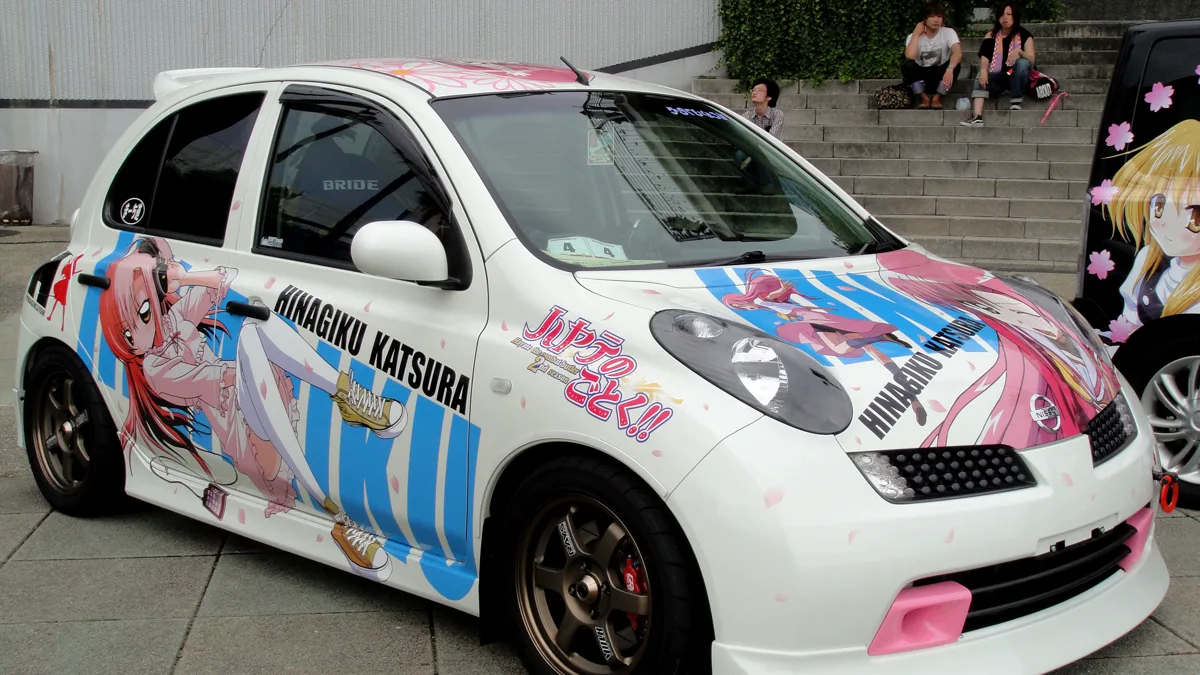
What Does Itasha Mean and Where Did Anime Cars Originate?
The itasha meaning translates literally from Japanese as “painful car,” combining the root itai (painful or cringe-inducing) and sha (vehicle). The phrase originated as a self-deprecating pun during the 1980s and 1990s, referencing both the financial pain of vehicle modifications and the social awkwardness of public anime fandom.
To understand modern itasha cars, you have to look back at Japanese automotive history. During Japan’s economic bubble in the 1980s, imported Italian sports cars were status symbols on Tokyo avenues. Enthusiasts jokingly referred to them as Ita-sha, an abbreviation for Italian automobiles. As high-tax maintenance and repair expenses drained owner wallets, the phonetic pun shifted toward itai (painful). By the late 1990s, otaku subculture adopted the term to describe modifying economy hatchbacks and sedans with hand-cut character vinyl decals, just as earlier grassroots builders did with domestic club stickers.
In those early years, decorating an itasha car was strictly an underground DIY hobby centered around Tokyo’s Akihabara electronics district and Osaka’s Nipponbashi, where graphic styling trends often originate. Builders cut single-color vinyl plots by hand, layering adhesive films over hoods and rear quarter glass. As detailed in comprehensive historical records on Wikipedia’s itasha documentation, the movement transitioned from amateur sticker-bombing to professional motorsport livery in 2008, when Goodsmile Racing fielded a fully wrapped Hatsune Miku BMW Z4 in Japan’s premier Super GT championship series.
Today, the culture has evolved into an international styling movement celebrated at premier gatherings like Odaiba Itasha Tengoku in Tokyo, which routinely hosts over one thousand vehicles. According to field documentation published by Speedhunters on Japanese car culture, the hallmark of a cohesive itasha build at gatherings like Tokyo’s Itasha Tengoku is matching the vehicle’s body lines to the artwork rather than stretching a flat illustration across door moldings. What started as self-mockery has earned its place alongside drift cars, VIP sedans, and classic Japanese domestic styling.
What Are the Three Commitment Levels of an Itasha Build?
An itasha build generally falls into three progressive commitment levels: cockpit interior styling, spot panel decals, or full printed vehicle wraps. Choosing the right tier depends on whether your vehicle functions as a dedicated weekend showpiece or an everyday commuter navigating workplace parking lots.
Newcomers often believe that committing to the style requires spending thousands of dollars on a bumper-to-bumper commercial print job. In reality, experienced builders recommend building your project in stages so you can evaluate how comfortable you feel driving the vehicle every day. That does not mean you must do everything at once; the three primary build tiers divide into distinct commitment levels:
- Level 1 (Cockpit Interior Styling): This subtle tier focuses on personalizing the cabin space where you spend your commute. Upgrades include custom shift boots, character floor mats, steering wheel accents, and small dashboard charms. The exterior remains understated, allowing you to enjoy your favorite aesthetic privately without drawing street scrutiny.
- Level 2 (Spot Panel Decals & Partial Graphics): The exterior build begins with targeted die-cut graphics placed on specific panels, such as rear quarter glass, fender arches, or the center of the hood. Spot decals allow you to test your color story and observe how road wash affects adhesive edges without covering broad body surfaces.
- Level 3 (Half-Wrap to Full Commercial Livery): The most extensive build tier involves large-format printed vinyl covering entire door skins, side profiles, fenders, and quarter panels. These liveries integrate graphic character portraits with dynamic motorsport stripes, geometric sponsor blocks, and multi-layered background textures.
If you are customizing a primary daily driver, starting at Level 1 or Level 2 provides practical flexibility. You can enjoy the visual culture, refine your maintenance routine, and ensure your vehicle remains workplace-appropriate before commissioning a comprehensive full-body wrap.
How Do You Plan an Itasha Design Across Vehicle Panels?
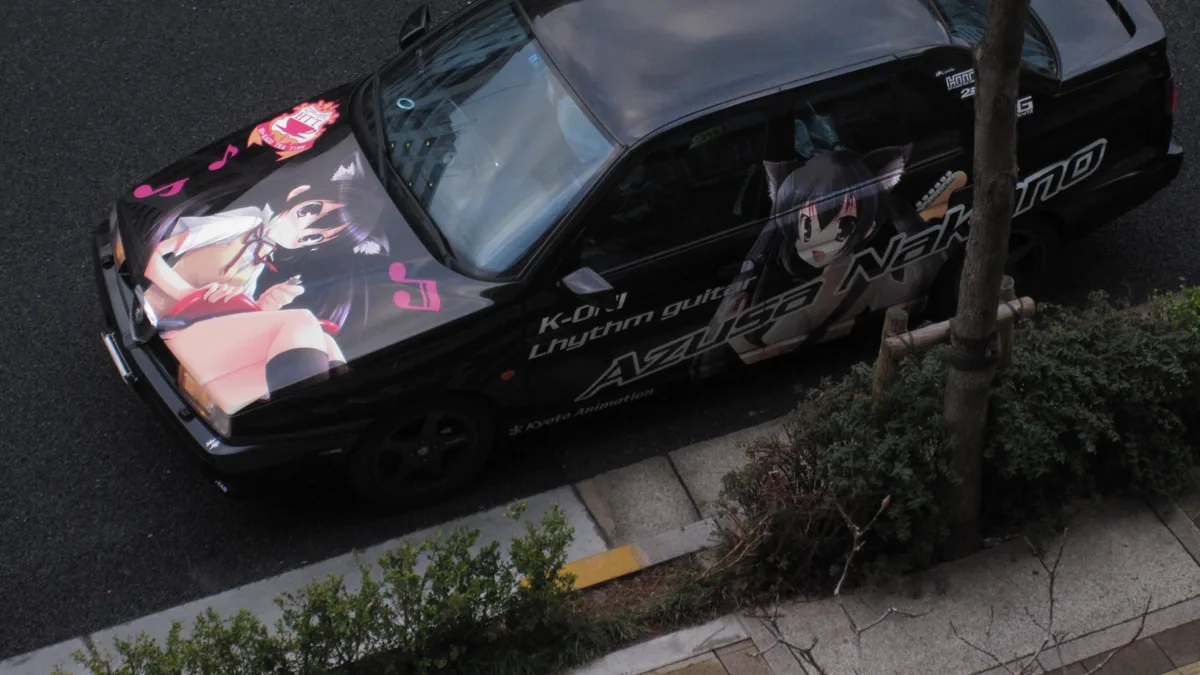
When planning an itasha design, you should map high-resolution vector artwork onto a scale template of your exact car model. Successful layouts align the character’s face away from door handles, fuel doors, and sharp body creases, creating a seamless visual flow from the front fender to the rear taillight.
A vehicle is not a flat sheet of poster paper; it is a three-dimensional sculpture defined by compound curves, panel seams, weatherstripping, and functional hardware. If you place a character’s eyes directly across a door handle recess or cut through their chin with an unpainted plastic rub strip, the entire design appears distorted. Professional wrap designers follow five fundamental layout rules:
- Locate key focal points in open sheet metal: Position primary character faces on broad, uninterrupted areas such as the rear doors or the center 70% of the hood. Keep intricate details at least three inches away from panel edges.
- Account for body seam wrap-around: Vinyl installers require at least half an inch of excess bleed around doors, hood gaps, and wheel arches to wrap the film securely into jambs. Ensure your artwork files include sufficient background margin.
- Coordinate your vehicle color story: Do not let character artwork clash with your base vehicle paint. If your car is pearl white, use the character’s secondary costume colors (such as deep crimson, violet, or electric blue) for livery stripes and geometric accents.
- Use high-resolution source files: Never enlarge web screenshots for vehicle printing. Professional print shops require vector line art or 300 DPI raster files scaled at 1:10 ratio to prevent blurry, pixelated rendering at full vehicle scale.
- Respect door jambs and visual breaks: When doors swing open, exterior vinyl cuts can expose contrasting body paint underneath. Planning complementary secondary decals inside the door frames creates a finished, intentional appearance.
Taking the time to measure your panels with a flexible tailor’s tape before finalizing graphics prevents costly reprint fees. A design that looks balanced on a flat computer monitor must work harmoniously when viewed from a three-quarters street angle.
Cast vs Calendered Vinyl: What Materials Survive on a Daily Driver?
Cast vinyl is the only material recommended for vehicle wraps because it possesses zero dimensional memory, resists shrinking, and conforms effortlessly to deep body recesses. Calendered vinyl is thicker, prone to shrinkage, and frequently lifts around curved edges after prolonged sun exposure.
The manufacturing process determines how vinyl behaves under outdoor weather. Cast vinyl begins as a liquid poured onto a casting sheet, creating a thin (around 2 to 3 mil), highly flexible film that experiences no internal stress. In contrast, calendered vinyl is produced by rolling molten PVC through heavy steel cylinders like dough. Over time, heat and UV radiation cause calendered vinyl to pull back toward its original shape, leading to lifted corners and cracked seams along body moldings, determining whether vinyl wraps can survive daily highway debris.
| Specification | Premium Cast Vinyl (3M 2080 / Avery MPI 1105) | Intermediate Calendered Vinyl |
|---|---|---|
| Film Thickness | 2.0 to 3.2 mil (thin, highly conformable) | 3.5 to 6.0 mil (stiff, thick edges) |
| Vertical Lifespan (Doors) | 4 to 5 years with UV over-laminate | 1 to 2 years before shrinking |
| Horizontal Lifespan (Hood/Roof) | 2 to 3 years under direct sunlight | 6 to 12 months before embrittlement |
| Removability | Clean release with heat; leaves minimal residue | High adhesive transfer; risks paint damage |
| Best Application | Full body wraps, complex curves, daily drivers | Flat short-term decals, temporary banners |
Daily maintenance plays an equally critical role in wrap longevity. As experienced builders document in Reddit’s itasha community discussions, daily driving an anime wrap requires abandoning automatic car washes entirely. Spinning brushes catch exposed vinyl edges and cause laminate clouding, making a two-bucket hand wash with pH-neutral soap the only dependable way to reach a 4-year lifespan.
Remember that horizontal surfaces receive significantly harsher exposure than vertical doors. The hood and roof absorb direct overhead ultraviolet light and heat from the engine bay. To keep your graphics looking crisp, park in shaded structures or an indoor garage whenever possible and apply a vinyl-safe ceramic spray sealant every two months to slow UV oxidation.
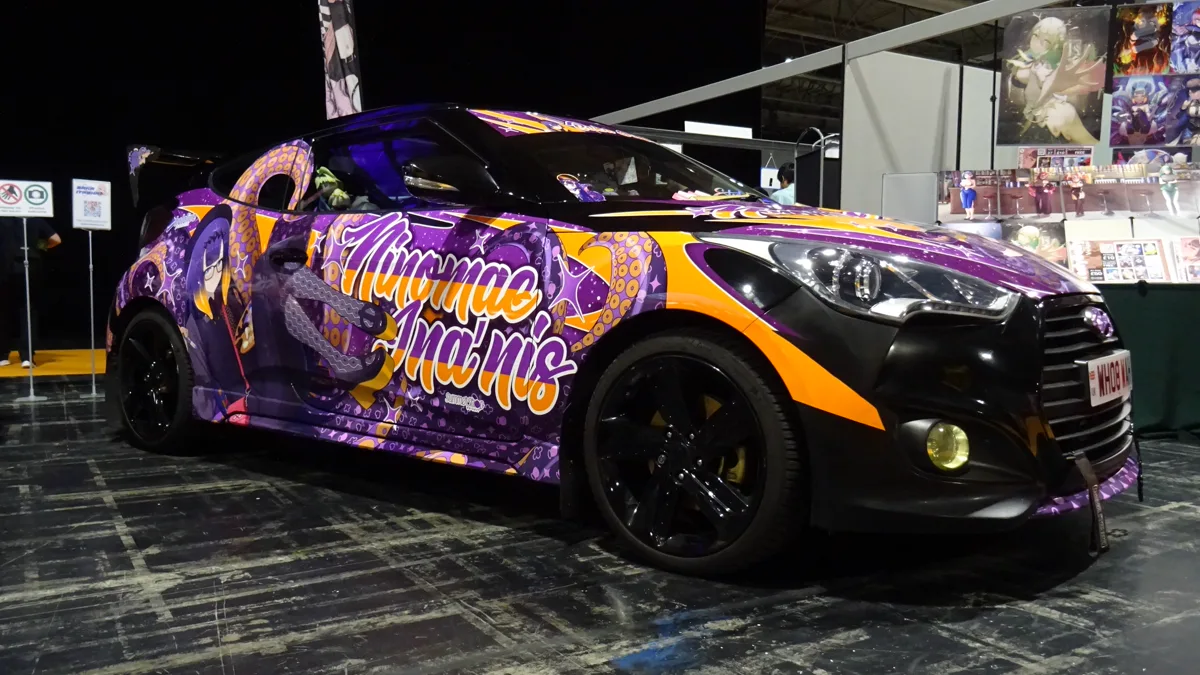
Are Anime Car Wraps Legal on Street Windows and Lights?
Anime car wraps are completely street legal across exterior body panels in all 50 states, provided they do not display explicit content, obstruct primary driver sightlines, or alter required vehicle lighting. Vision glass and lighting assemblies face strict federal and state safety regulations.
When modifying a street car, styling must never compromise road safety. Applying opaque vinyl graphics across front windshields or driver side windows creates an immediate traffic hazard and will fail annual vehicle inspections. Every builder must observe four core safety boundaries:
- Windshield Glass Restrictions: Solid vinyl is strictly prohibited across front windshields. Regulations permit non-reflective tint strips only along the upper windshield border above the manufacturer’s AS-1 line (typically the top 4 to 5 inches).
- Side Vision Glass: Driver and front passenger side windows must maintain an unobstructed view. While small corner inspection decals are customary, sweeping character graphics must not cover front side glass.
- Rear Windows and Perforated Film: Rear side quarter glass and back windshields may carry graphics if printed on approved perforated window vinyl (such as a 50/50 or 60/40 hole pattern). Perforated vinyl displays artwork on the outside while allowing the driver to see through the glass from the interior cabin.
- Headlights and Taillights: Never wrap over headlights, taillights, or amber lights with colored vinyl films that reduce luminous output or alter mandated beam patterns.
Check your state: Vehicle glass and visual obstruction rules vary across jurisdictions. In California, California Vehicle Code Section 26708 strictly prohibits driving any motor vehicle with objects or materials placed upon windshields or side windows that reduce driver visibility. At the federal level, glazing materials must satisfy standards outlined in NHTSA FMVSS No. 205. Always confirm your local motor vehicle statutes before applying window graphics.
What Does an Itasha Build Cost from Concept to Installation?
A full professional itasha wrap typically costs between $3,200 and $6,500, encompassing custom character illustration, graphic livery layout, commercial cast vinyl printing, and certified installation labor. Budget-conscious builders can complete a partial side-panel project for $800 to $1,800.
Understanding the budget breakdown from initial concept to installation helps manage total vinyl cost. The total investment divides into four distinct categories:
- Character Artwork & Licensing ($300 to $900): Commissioning a specialized digital artist to illustrate original character poses at high printable resolutions represents the first stage. Ensure the illustrator grants you personal vehicle usage rights.
- Graphic Livery Layout ($300 to $800): A wrap designer takes the character illustration and creates the background color story, vector patterns, and vehicle template layout fitted to your specific car model.
- Materials & Large-Format Printing ($800 to $1,800): Printing on premium cast film (such as 3M IJ180mC or Avery MPI 1105) followed by heat-laminating with UV-protective gloss or satin film protects the ink from road debris.
- Professional Installation Labor ($1,200 to $3,000): Skilled installers clean the paint, remove door handles and trim pieces, stretch the vinyl without over-heating, and tuck all edges into body seams.
For enthusiasts working with limited funds, starting with Level 2 partial graphics offers outstanding value. Wrapping just the hood or applying large die-cut character silhouettes along the doors delivers striking visual impact while saving substantially on labor and material expenses.
Planning Your Finished Vehicle Project
Building an itasha is one of the most rewarding ways to express your personal interests through automotive styling. It transforms your vehicle from an anonymous appliance into an energetic reflection of your passions, sparking conversations with fellow enthusiasts at weekend meets and automotive shows.
The secret to building a vehicle that earns respect on the street is patience and discipline. Do not rush out to purchase unvetted sticker packs or apply low-grade banner film to your daily driver. Plan your color story around two or three harmonious shades, measure every body panel carefully, select premium cast vinyl with UV protection, and maintain your surfaces with regular two-bucket hand washes. By combining creative fandom with sound craftsmanship, your itasha car will turn heads for years to come.
How we researched this: Guide built using verified vehicle wrap technical specifications, federal motor vehicle safety guidelines, and active community builder documentation.
Sources: Wikipedia Itasha Archive, Speedhunters Car Culture, NHTSA FMVSS 205, California Vehicle Code 26708, and r/Itasha owner records. Explore our complete collection of itasha design guides for deeper build tutorials.
Garage questions
Will an itasha wrap ruin my original car paint?
No. When applied over sound original paint and removed using controlled heat within its recommended service life (typically 4 to 5 years for cast vinyl), vehicle wrap film actually shields your clearcoat from light rock chips and sun damage. However, wrapping over damaged paint, peeling clearcoat, or unbaked body filler will cause paint to lift during removal.
Can I run an itasha through an automatic car wash?
Never run a wrapped vehicle through an automated car wash equipped with rotating nylon brushes. The high-speed bristles catch on vinyl edges, lift delicate corners, and leave micro-scratches across the protective over-laminate. Hand washing with the two-bucket method and pH-neutral soap is the safest way to maintain your finish.
How long does an anime car wrap last on a daily driver?
On vertical surfaces like door panels and fenders, premium cast vinyl with UV lamination lasts 4 to 5 years. On horizontal surfaces like the hood and roof, intense solar radiation and engine heat reduce the practical lifespan to approximately 2 to 3 years before replacement is needed to prevent adhesive baking.
Can I design my own itasha without hiring a graphic artist?
Yes, if you possess graphic design skills and understand high-resolution print production. You must work on accurate 1:1 or 1:10 scale vehicle blueprints and ensure all artwork is created in vector format or high-resolution raster files at 150 to 300 DPI to prevent pixelation during large-format commercial printing.
Is it legal to put anime decals on my rear car window?
Yes, in most states you can apply graphics to rear side windows and back windshields provided you use perforated window film (typically 50/50 or 60/40 pattern) and your vehicle is equipped with dual side mirrors that maintain clear rearward visibility. Always verify your specific state vehicle codes before installation.